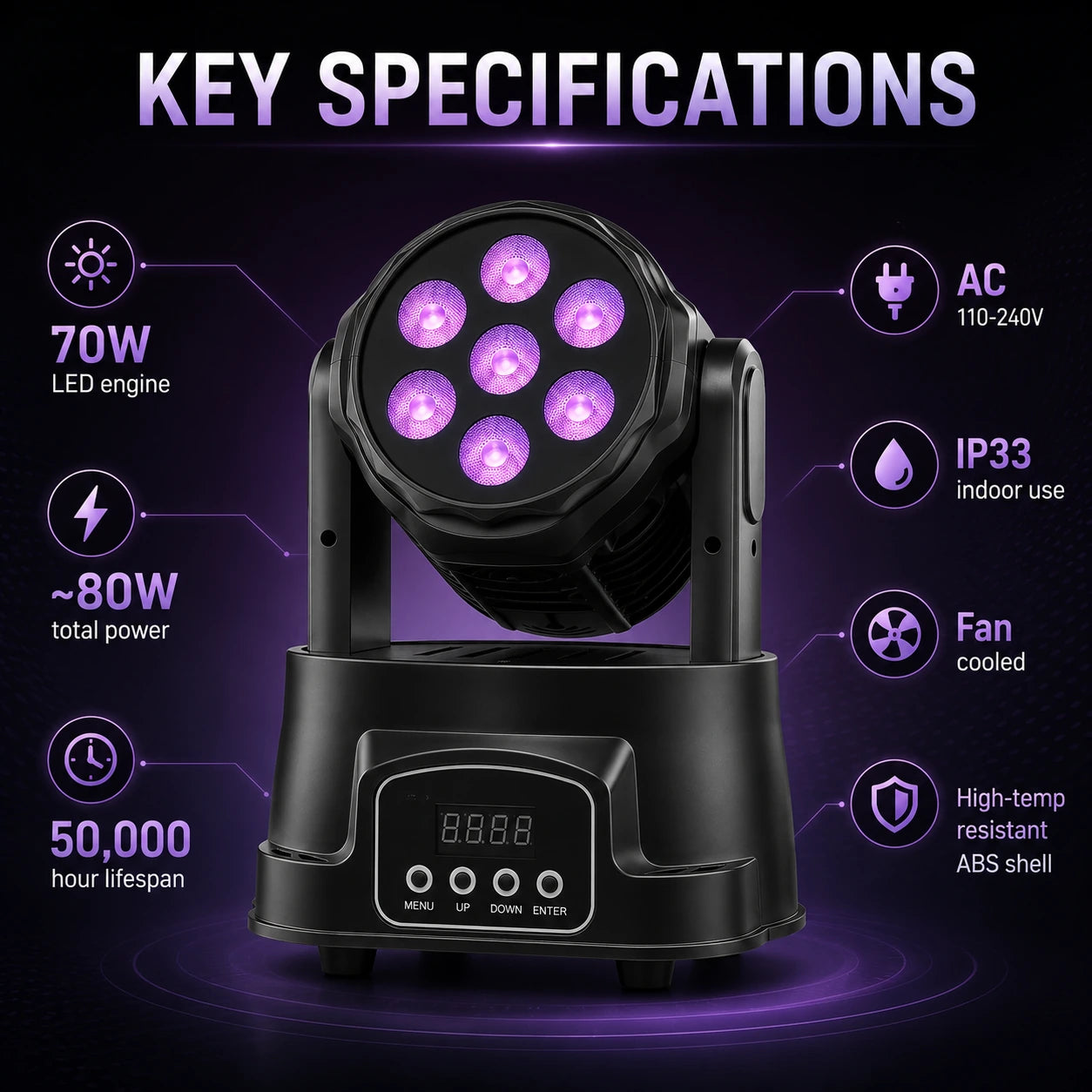
SF-MW710 LED Mini Wash Moving Par Light
Couldn't load pickup availability
1-Year Warranty Included
Same-Day Shipping (Order by 12PM EST)
Expert Support: Call (866) 577-8743
Shipping information
Shipping information
Warranty information
Warranty information
The SF-MW710 is a mini wash moving head — a compact moving par light that produces smooth, wide washes of color instead of focused beams or projected patterns. Seven 10W RGBW 4-in-1 LEDs deliver full-spectrum color mixing: dial in any shade from deep saturated primaries to subtle pastels to clean white, all with independent Red, Green, Blue, and White control. At 25° beam angle with 540°/270° pan/tilt, the MW710 covers stages, walls, dance floors, and performers with soft, even color — exactly the kind of light that beam and spot fixtures can't provide. 9/14 DMX channels, sound-active mode, master/slave sync, and auto-run programs. Under 7 pounds. Under $150. The wash light that completes your rig.
What a Wash Fixture Does
Stage lighting breaks down into three fundamental types: beam, spot, and wash. Each serves a different purpose.
| Type | What It Does | Visual Character |
|---|---|---|
| Beam | Produces a tight, concentrated shaft of light visible mid-air | Hard-edged, dramatic, punchy — best through haze/fog |
| Spot | Projects focused patterns (gobos) onto surfaces | Sharp, defined, textured — patterns on walls/floors/performers |
| Wash | Floods an area with soft, even, blended color | Smooth, wide, uniform — entire surfaces bathed in color |
The SF-MW710 is a wash. It doesn't project patterns. It doesn't create narrow beam shafts. It fills space with color. A wall goes from flat white to deep blue. A stage goes from dark to warm amber. A dance floor goes from invisible to pulsing in magenta. Wash is the foundation layer — the color that sets the mood before beams and spots add drama on top.
What Makes the MW710 a "Moving Par"
A traditional par can (par light) is a simple, static fixture: point it at a surface, it washes that surface in color. The MW710 takes the same concept — RGBW LEDs producing a wide color wash — and mounts it on a motorized pan/tilt yoke. The result: a par light that moves. Pan 540° horizontally. Tilt 270° vertically. Sweep color across a stage. Track a performer. Alternate between washing the dance floor and washing the ceiling. All the versatility of a moving head, all the smooth color of a par light.
What's Inside
| System | What It Does |
|---|---|
| 7× 10W RGBW LEDs | Seven individually addressable LED emitters, each containing Red, Green, Blue, and White chips — 70W total LED power |
| RGBW Color Mixing | Independent intensity control of each color channel — mix any color from millions of possible combinations |
| 25° Beam Angle | Wide enough for smooth coverage, focused enough to direct — a balanced wash angle for versatile use |
| Pan/Tilt | 540° horizontal pan, 270° vertical tilt — full overhead coverage with electronic correction |
| Dimmer | 0–100% smooth electronic dimming — seamless fades from blackout to full output |
| Strobe | Variable electronic strobe — slow pulse to rapid flash |
Who It's For
The MW710 serves anyone who needs color in their lighting rig. Mobile DJs who want their dance floor, DJ booth, or venue walls bathed in color that moves and changes with the music. Small venues — bars, restaurants, lounges, and event halls — that want ambient mood lighting with the ability to shift colors throughout the evening. Houses of worship that need soft stage washes for services, with the flexibility to add color for special events. Event professionals running weddings, corporate events, and social gatherings where the right color creates the right atmosphere. And anyone building a lighting rig who already has beam or spot fixtures and needs the wash layer to complete the picture.
How RGBW 4-in-1 Color Mixing Works
Each of the MW710's seven LEDs contains four separate chips inside a single emitter: Red, Green, Blue, and White. Each chip's brightness is independently controllable from 0–100%. By adjusting the ratio of these four channels, you can produce virtually any color — from pure saturated primaries to subtle pastels to warm or cool whites.
RGBW vs. Color Wheel — Two Different Approaches
| Feature | RGBW Color Mixing (MW710) | Dichroic Color Wheel (BM60, SP90) |
|---|---|---|
| How It Works | Blends 4 LED colors electronically — infinite combinations | Rotates glass filters in front of a white LED — fixed preset colors |
| Available Colors | Millions — any shade, any saturation, any brightness | 7–8 preset colors + half-color blends |
| Color Transitions | Smooth electronic fades — seamless crossfades between any two colors | Mechanical wheel rotation — snaps between positions or spins through all colors |
| Custom Colors | Yes — dial in exact shades to match décor, branding, themes | No — limited to the colors on the wheel |
| White Light | Dedicated white LED chip — clean, bright, high-CRI white | Open position (no filter) — depends on LED color temperature |
| Best For | Wash, mood lighting, color matching, smooth fades | Beam effects, gobo projection, rapid color changes |
This isn't better or worse — it's different tools for different jobs. The BM60 and SP90 use color wheels because they're beam and spot fixtures focused on sharp projection. The MW710 uses RGBW mixing because it's a wash fixture focused on smooth, blended color. A professional rig uses both.
What You Can Mix
| Color | Mix Formula | Use |
|---|---|---|
| Pure Red | R: 100%, G: 0%, B: 0%, W: 0% | High-energy, dramatic, concert peaks |
| Deep Blue | R: 0%, G: 0%, B: 100%, W: 0% | Night scenes, cool atmosphere, worship |
| Warm Amber | R: 100%, G: 40%, B: 0%, W: 20% | Weddings, galas, warm intimate settings |
| Teal / Cyan | R: 0%, G: 80%, B: 100%, W: 0% | Modern events, corporate, cool elegance |
| Soft Lavender | R: 60%, G: 20%, B: 80%, W: 30% | Romantic settings, spring events, upscale ambiance |
| Clean White | R: 0%, G: 0%, B: 0%, W: 100% | General illumination, speeches, ceremony |
| Warm White | R: 30%, G: 15%, B: 0%, W: 100% | Soft, inviting atmosphere — similar to incandescent |
| Magenta | R: 100%, G: 0%, B: 80%, W: 0% | Dance floor energy, DJ sets, party atmosphere |
| Forest Green | R: 10%, G: 80%, B: 20%, W: 10% | Nature themes, holiday events, outdoor-inspired |
| Peach / Skin Tone | R: 100%, G: 60%, B: 40%, W: 40% | Flattering front wash for performers and speakers |
The White Channel Advantage
Many budget wash fixtures use RGB only (3 colors). When you mix RGB to create white, the result is often slightly tinted — greenish, pinkish, or uneven. The MW710's dedicated White chip solves this. Need clean white light for a ceremony, speech, or photo session? Set W to 100%, RGB to 0%. Need warm white? Add a touch of red and amber. The white channel also adds brightness and body when mixed with colors — a blue wash with white added is brighter and more present than pure blue alone.
CRI 85 — What It Means for Color
CRI (Color Rendering Index) measures how accurately a light source renders the colors of objects it illuminates. CRI 85 means the MW710 delivers good color accuracy — skin tones look natural, fabrics show their true colors, and the overall visual quality is well above basic LED fixtures (which often score CRI 65–75). For events where people are photographed, filmed, or simply viewed by other humans, CRI 85 ensures the lighting flatters rather than distorts.
Complete Specifications
| Specification | SF-MW710 |
|---|---|
| Fixture Type | Mini wash LED moving head (moving par) |
| Light Source | 7× 10W RGBW 4-in-1 LEDs (70W total LED power) |
| Total Power Consumption | ~80W (LEDs + motors + electronics) |
| LED Type | RGBW 4-in-1 (Red, Green, Blue, White in each emitter) |
| Color Mixing | Full RGBW — independent channel control, infinite combinations |
| CRI | 85 |
| LED Lifespan | 50,000 hours |
| Beam Angle | 25° |
| Pan Range | 540° (8/16-bit, electronic correction) |
| Tilt Range | 270° (8/16-bit, electronic correction) |
| Dimming | 0–100% smooth electronic |
| Strobe | Variable electronic strobe |
| DMX Channels | 9 / 14 channels (basic / extended mode) |
| Control Modes | DMX-512, master/slave, sound-activated, auto-run |
| Display | LED display with 4-button menu interface |
| Data Connections | 3-pin XLR DMX in/out |
| Power Input | AC 110–240V, 50/60Hz (universal voltage) |
| Construction | High-temperature resistant ABS plastic shell |
| Cooling | Fan cooled |
| IP Rating | IP33 (indoor use) |
| Dimensions | 11" × 10" × 9" (280 × 254 × 229 mm) |
| Weight | 6.61 lbs (3.0 kg) |
| SKU | SFX-MHP-001 |
Light Source Detail
| Feature | Detail |
|---|---|
| LED Configuration | 7 emitters × 10W each = 70W total LED power |
| Color Channels | RGBW 4-in-1 — each emitter contains Red, Green, Blue, and White chips |
| CRI | 85 |
| Lifespan | 50,000 hours (~17 years at 8 hrs/day) |
| Warm-Up | None — instant on at full output |
| Lamp Replacement | None required — LED source lasts the life of the fixture |
What the MW710 Is (and Isn't)
The MW710 is a dedicated wash fixture. It's optimized for one job: flooding surfaces with smooth, blended color. It does that job well, and at $149 it does it affordably. Here's what it's not:
- It's not a beam — the 25° wide output is designed to wash, not to cut through haze as a sharp shaft. For mid-air beam effects, pair it with the SF-BM60 or SF-SB100.
- It's not a spot — there are no gobos, no pattern projection. For projected textures and shapes, pair it with the SF-SP90.
- It's not a zoom fixture — the 25° angle is fixed. For variable beam-to-wash zoom, the SF-BM200 offers 0°–30° motorized zoom.
The MW710 isn't trying to be everything. It's a compact, affordable wash that complements beam and spot fixtures to create a complete lighting rig.
Applications
- Mobile DJ — Wash the dance floor in color. Wash the DJ booth. Wash the venue walls. Change colors with the music, beat-by-beat or slow fade across a set. Sound-active mode makes this hands-free.
- Weddings & Social Events — Match venue décor with precise custom colors. Warm amber for ceremony, soft lavender for cocktail hour, dynamic color for reception dancing. RGBW mixing lets you match the exact shade the client requested.
- Houses of Worship — Soft stage washes for services. Blue for reflective moments, warm white for sermons, color for special events and holidays. Gentle enough for worship, flexible enough for productions.
- Bars & Restaurants — Ambient mood lighting that changes throughout the evening. Cool tones early, warm tones late, themed colors for special nights. Auto-run mode keeps it running without an operator.
- Theater & Dance — Stage washes set scenes. Blue for night, amber for interior, green for forest, red for dramatic tension. Pan/tilt lets you redirect wash coverage between scenes without moving fixtures.
- Uplighting — Place on the floor and aim upward to wash walls, columns, or drapes. RGBW mixing ensures you can match any event theme. Seven MW710s around a reception hall creates transformative ambient color.
DMX-512 Control — Dual Channel Modes
The SF-MW710 connects via standard 3-pin XLR (in/out for daisy-chaining). Set the DMX start address and channel mode from the onboard LED display with 4-button menu interface. Two modes available:
| Mode | Channels | Best For |
|---|---|---|
| Basic | 9 channels | Simpler controllers, limited DMX universes, quick setup. Core pan/tilt, RGBW, dimmer, and strobe on fewer channels. |
| Extended | 14 channels | Full control — 16-bit fine pan/tilt, individual RGBW channels, speed, color macros, and function control all independently addressable. |
Extended Mode Channel Functions
| Function | Channels | What It Does |
|---|---|---|
| Pan (Horizontal) | 2 channels | 540° rotation — coarse + fine (16-bit precision) |
| Tilt (Vertical) | 2 channels | 270° range — coarse + fine (16-bit precision) |
| Pan/Tilt Speed | 1 channel | Movement speed — fast snaps to slow, cinematic sweeps |
| Dimmer & Strobe | 1 channel | 0–100% dimming + variable strobe speed |
| Red | 1 channel | 0–100% red intensity |
| Green | 1 channel | 0–100% green intensity |
| Blue | 1 channel | 0–100% blue intensity |
| White | 1 channel | 0–100% white intensity |
| Color Macros | 1 channel | Pre-programmed color presets — select popular colors without manually mixing RGBW |
| Color Speed | 1 channel | Transition speed for color macro changes |
| Movement / Functions | 1 channel | Auto programs, sound-active trigger, reset |
16-Bit Pan/Tilt Precision
In extended mode, pan and tilt each get two DMX channels: one for coarse positioning (fast jumps) and one for fine adjustment (65,536 discrete positions across the full range). The practical result: slow pan sweeps that are buttery smooth with no visible stepping. This matters most during slow, cinematic movements — washing a stage from left to right over 10 seconds, or slowly tilting down to reveal a performer. 8-bit (basic mode) is fine for fast movements; 16-bit is essential for slow, deliberate, visible movement.
DMX Universe Planning
In extended mode (14 channels): 36 MW710 fixtures per DMX universe (36 × 14 = 504 of 512). In basic mode (9 channels): 56 fixtures per universe (56 × 9 = 504). If you're mixing MW710 wash fixtures with BM60 beam fixtures on the same universe, plan your addresses: for example, 10× MW710 at 14CH = 140 addresses, plus 10× BM60 at 11CH = 110 addresses = 250 total, well within a single universe.
Non-DMX Control Modes
| Mode | How It Works | Best For |
|---|---|---|
| Sound-Activated | Built-in microphone triggers color changes, movement, and strobe in response to music and ambient sound. | DJ gigs, parties, dance floors — reactive lighting without programming |
| Auto-Run | Built-in programs cycle through color combinations, fades, and movement patterns automatically. | Ambient installations, venues without operators, set-and-forget |
| Master/Slave | Connect multiple MW710s via DMX cable. Master runs auto or sound mode; all slaves follow in sync. | Multi-fixture wash arrays — coordinated color changes across the room with no controller |
Frequently Asked Questions
What's the difference between the MW710 and the BM60?
Completely different fixture types. The SF-BM60 ($199) is a beam/gobo fixture — 60W white LED, dichroic color wheel (7 preset colors), gobo wheel (7 patterns), focused beam output. The MW710 ($149) is a wash fixture — 7×10W RGBW LEDs, full color mixing (millions of colors), no gobos, no patterns, wide 25° wash output. The BM60 projects patterns and creates mid-air beam shafts. The MW710 floods surfaces with smooth, blended color. They're designed to work together: MW710 for the color foundation, BM60 for the beam drama on top.
Why would I buy this instead of a static par can?
A static RGBW par can washes whatever it's pointed at — and that's it. The MW710 does the same thing but moves. Pan 540°, tilt 270°. Sweep color across the room. Alternate between stage wash and wall wash. Track performers. Create dynamic movement during high-energy moments, then park in position for a static wash during calm moments. The pan/tilt motor is the difference between a light that sits and a light that performs.
Can I use it for uplighting?
Yes. Place MW710s on the floor at the base of walls, columns, or drapes and aim them upward. RGBW mixing lets you dial in any color to match the event theme. The motorized tilt even lets you adjust the wash angle without physically moving the fixture. For wedding or gala uplighting, MW710s are an effective and flexible option — and at $149 each, deploying 6–10 around a room is financially viable.
Do I need a DMX controller?
No. The MW710 runs in sound-active mode (reacts to music), auto-run mode (built-in color programs cycle automatically), and master/slave mode (sync multiple units without a controller). DMX gives you precise RGBW control and the ability to program exact colors and cues, but the MW710 works straight out of the box with just a power cable.
How many colors can it actually produce?
With 4 channels (RGBW) each at 256 levels (0–255 via DMX), the theoretical maximum is 256⁴ = over 4.2 billion combinations. In practice, many of those combinations are visually indistinguishable from each other. The real answer: effectively unlimited color options — any hue, any saturation, any brightness level you can imagine. More than enough to match any event theme, brand color, or creative vision.
What's the difference between 9-channel and 14-channel mode?
9-channel (basic) gives you pan, tilt, dimmer/strobe, RGBW, and speed on fewer channels — simpler to program, uses less DMX address space. 14-channel (extended) adds fine pan/tilt (16-bit precision), color macros, color speed, and full function control on independent channels. Use basic when simplicity matters; use extended when you want maximum creative control and smooth slow movements.
How many can I run on one power circuit?
Each unit draws approximately 80W at full output. On a 15A/120V circuit (1,800W available): up to 20 fixtures with headroom (20 × 80W = 1,600W). On a 20A circuit (2,400W): up to 28 fixtures. The MW710's low power draw is ideal for multi-fixture wash deployments — you can run a full-room uplighting setup on a single circuit.
Is it outdoor rated?
No. IP33 is an indoor rating. Not waterproof. Use indoors or under fully covered/tented outdoor stages only.
Is the white LED "warm" or "cool"?
The white chip produces a clean daylight-range white. To create warm white (similar to incandescent or tungsten), add red and a touch of green to the white: W: 100%, R: 30%, G: 15%, B: 0%. To create cool white (similar to daylight or fluorescent), add a touch of blue: W: 100%, R: 0%, G: 0%, B: 15%. RGBW mixing gives you full control over white color temperature — something a fixed white LED cannot do.
Setup Tips
Build Your Colors Before the Event
If you're running DMX, program your color presets during a rehearsal or sound check — not during the event. Dial in the exact warm amber for ceremony, the specific blue for cocktail hour, the precise magenta for the dance set. Save these as scenes or cues. During the event, you recall perfect colors with one button press instead of fumbling with four RGBW faders live.
Use Slow Fades, Not Snaps
RGBW color mixing enables something color wheels can't: smooth crossfades between any two colors. A 4–8 second fade from warm amber to soft blue looks elegant and intentional. An instant snap looks jarring. The MW710's electronic mixing makes slow fades seamless — use that capability. Save the fast snaps for high-energy DJ moments.
White Isn't Just White
The dedicated white channel is your most versatile tool. Pure white for speeches and ceremonies. Warm white (add red) for dining and conversation. Cool white (add blue) for modern/corporate. Don't overlook white just because color is more exciting — a great warm white wash during dinner service is often the most appreciated lighting of the entire event.
Pair Wash with Beam
The MW710 is at its best when paired with beam or spot fixtures. The wash provides the color foundation — the smooth, even layer that sets mood and atmosphere. Beam fixtures (BM60, SB100) add the dramatic shafts of light and gobo effects on top. This layered approach — wash underneath, beam on top — is how professional lighting designers build shows at every level from small clubs to arena tours.
Master/Slave for Consistent Color
If you're running multiple MW710s as uplighting around a room, master/slave mode ensures every fixture shows the exact same color at the exact same time. No DMX controller needed — cable them together, set one as master, and every unit in the chain follows. This is the fastest path to coordinated, professional-looking room lighting with zero programming.
Pairs Well With
- SF-BM60 Mini Beam — The natural companion. MW710 washes for color; BM60 beams for drama. Under $350 per pair. The most affordable complete beam+wash moving head combo in the lineup.
- SF-SP90 Gobo Spot — Add gobo projection to your wash. MW710 colors the stage; SP90 projects patterns over it.
- SF-BM200 3-in-1 — The BM200 handles beam, spot, and narrow wash. Add MW710s for wide-area color coverage the BM200's tight angles can't reach.
- Haze FX — Haze doesn't just benefit beams — even wash fixtures gain depth and dimension when light has particles to interact with. Light haze makes the entire room feel more immersive.
- All Stage Lighting — Wash is the foundation layer. It pairs with everything.
💡 Overview & Wash
What Wash Does
Wash = smooth, wide, blended color across surfaces. Not beams (tight shafts), not spots (projected patterns). Wash is the color foundation that sets mood and atmosphere.
| LEDs | 7× 10W RGBW 4-in-1 (70W total) |
| Color | Full RGBW mixing — millions of colors |
| Beam Angle | 25° wide wash |
| Movement | 540° pan, 270° tilt |
| CRI | 85 |
A "moving par" — same RGBW color wash as a par can, but on a motorized yoke that pans and tilts. Sweep color across the room instead of pointing at one spot.
🎨 RGBW Color
How RGBW Works
Each LED has 4 chips (Red, Green, Blue, White), each controllable 0–100%. Mix any color. Over 4 billion possible combinations.
RGBW vs Color Wheel
Color wheels (BM60, SP90) = 7 preset colors. RGBW mixing = any color you want. Different tools, designed to work together.
Popular Mixes
- Warm Amber — R:100%, G:40%, W:20%
- Deep Blue — B:100%
- Soft Lavender — R:60%, G:20%, B:80%, W:30%
- Clean White — W:100%
- Warm White — W:100%, R:30%, G:15%
📐 Full Specs
| Type | Mini wash LED moving head |
| LEDs | 7× 10W RGBW 4-in-1 (70W) |
| Total Power | ~80W |
| CRI | 85 |
| Lifespan | 50,000 hours |
| Beam Angle | 25° |
| Pan / Tilt | 540° / 270° (16-bit) |
| Dimming | 0–100% electronic |
| Strobe | Variable electronic |
| DMX | 9 / 14 channels |
| Control | DMX-512, master/slave, sound-active, auto |
| Power | AC 110–240V, 50/60Hz |
| IP | IP33 (indoor) |
| Dimensions | 11" × 10" × 9" |
| Weight | 6.61 lbs (3.0 kg) |
Smallest and lightest in the SurgeFX moving head lineup. Dedicated wash — no gobos, no prism, no zoom. Optimized for smooth RGBW color.
🎛️ DMX & Control
Dual DMX Modes
| Basic (9 CH) | Pan, tilt, RGBW, dimmer/strobe, speed |
| Extended (14 CH) | Adds 16-bit fine pan/tilt, color macros, color speed, functions |
Universe Planning
Extended: 36 per universe. Basic: 56 per universe.
No-Controller Modes
- Sound-Active — Mic reacts to music
- Auto-Run — Built-in programs cycle
- Master/Slave — Sync multiple units
❓ FAQ & Tips
MW710 vs BM60?
Different fixture types. MW710 = wash (smooth color, RGBW mixing). BM60 = beam/gobo (focused patterns, color wheel). Designed to work together.
Need a controller?
No. Sound-active, auto-run, and master/slave work without one.
Works for uplighting?
Yes. Place on floor, aim up. RGBW matches any event color.
Per circuit?
~80W each. Up to 20 per 15A/120V circuit.
Key Tips
- Build colors before the event — Program RGBW presets during setup
- Slow fades > snaps — RGBW enables seamless crossfades, use them
- White isn't just white — Add red for warm, blue for cool
- Pair wash with beam — Wash underneath, beam effects on top
- Master/slave for uplighting — Same color, every unit, zero programming
Pairs Well With