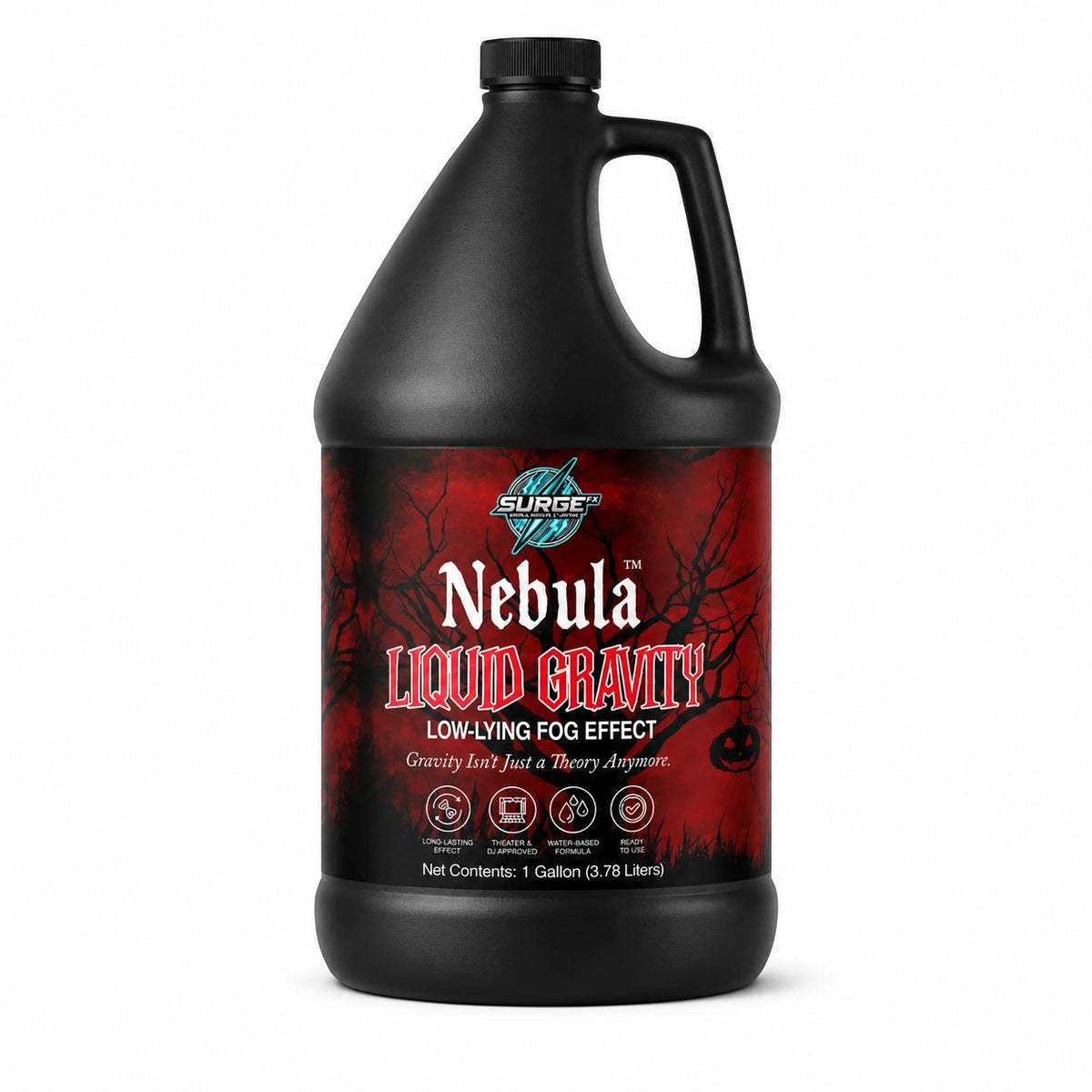
Nebula™ Liquid Gravity – Low-Lying Fog Solution
Couldn't load pickup availability
Pro-Grade, Machine-Safe Formula
Same-Day Shipping (Order by 12PM EST)
Expert Support: Call (866) 577-8743
Shipping information
Shipping information
Returns
Returns
Dense. Ground-Hugging. The Fog That Stays at Your Feet.
Nebula™ Liquid Gravity is a specialty fog fluid engineered exclusively for low-lying fog machines and fog chillers. It produces thick, dense fog that hugs the floor — rolling across the ground in heavy waves without rising or dispersing upward. The "walking on clouds" effect for wedding first dances, the graveyard crawl for haunted attractions, the dramatic stage entrance that appears from nowhere.
This is not a standard fog fluid. Standard fog rises and fills the air. Liquid Gravity is formulated to stay low — creating floor-level atmosphere that enhances the scene without obscuring sightlines, performers, or lighting above ground level.
Water-based, residue-free, ready to use. Compatible with all major low-lying fog machines and fog chillers. Made in the USA. 1 gallon (3.78 liters).
How Low-Lying Fog Works
All fog naturally rises as it warms to room temperature. Low-lying fog stays on the ground because the machine chills the fog output before releasing it — cold fog is denser than the surrounding air, so it sinks and rolls along the floor. As it gradually warms, it dissipates rather than rising into a cloud.
Liquid Gravity is formulated to maximize this ground-hugging behavior. The fluid produces a denser vapor that responds well to the chilling process, stays low longer, and creates thick, visible coverage at floor level. Paired with the right machine, the result is a dramatic, rolling blanket of fog that looks like it's alive.
| Feature | Nebula™ Liquid Gravity |
|---|---|
| Size | 1 gallon (3.78 liters) |
| Formula Type | Low-lying fog fluid (water-based) |
| Fog Behavior | Ground-hugging — stays at floor level |
| Output Character | Dense, heavy, rolling waves |
| Color | White |
| Residue | None |
| Scent | Neutral |
| Compatibility | Low-lying fog machines, fog chillers |
| Use | Indoor & outdoor |
| Made In | USA |
Best For
- Wedding first dances — The classic "dancing on clouds" effect. Dense, low fog rolling across the dance floor while the couple is fully visible above it. The single most requested use for low-lying fog.
- Theatrical performances — Graveyard scenes, dreamscapes, mystical entrances. Floor fog adds atmosphere without hiding actors or blocking stage lighting.
- Haunted houses & Halloween — Ground-crawling fog through graveyard sets, corridor creep effects, eerie floor coverage that masks where guests are stepping.
- Stage reveals & entrances — Performers emerging from a fog-covered stage. The fog at their feet makes the entrance feel otherworldly.
- Concert & event production — Floor fog during slow songs, key moments, or set changes. Adds visual depth without affecting lighting or visibility.
- Film & photography — Controlled ground fog for cinematic shots. Low fog photographs dramatically with proper backlighting.
Fog Fluid Line — Which Formula Do You Need?
SurgeFX offers multiple fog fluid formulas, each optimized for different behavior. The key question: do you need fog that rises (standard) or fog that stays on the ground (low-lying)?
| Formula | Behavior | Best For |
|---|---|---|
| Nebula™ Core | Standard — rises & fills | All-purpose, general use |
| Nebula™ Mirage | Standard — quick dissipating | Fast transitions, scene changes |
| Nebula™ Eternal | Standard — long-lasting | Extended scenes, sustained fog |
| Nebula™ Endure | Standard — wind-resistant | Outdoor events, open-air stages |
| Nebula™ Liquid Gravity ← This Product | Low-lying — ground-hugging | Weddings, theater, haunts, reveals |
Liquid Gravity vs. Dry Ice
Dry ice also creates low-lying fog, but comes with significant handling requirements: specialized storage, handling burns risk, limited availability, and you can't control the output once the ice is in the water. Liquid Gravity paired with a dedicated low-lying fog machine gives you the same visual effect with repeatable, controllable, on-demand output — no special handling, no sourcing issues, no safety risks from frozen CO₂. For professional operators who run this effect regularly, fluid-based machines eliminate the dry ice logistics entirely.
Will this work in a standard fog machine?
The fluid itself works in any fog machine — but it won't produce low-lying fog without a chilling system. In a standard fog machine, Liquid Gravity will produce standard rising fog. To get the ground-hugging effect, you need either a dedicated low-lying fog machine (like the SurgeFX Hydra or Hydra Mini) or a standard fog machine paired with a fog chiller. The machine chills the fog so it's denser than room air — that's what makes it sink and stay low.
How long does it stay on the ground?
The fog stays low as long as it remains cooler than the surrounding air. In a still indoor environment with moderate room temperature, you can expect the fog to hug the floor for several minutes before it warms, thins, and dissipates. Factors that affect how long it stays low: room temperature (cooler rooms = longer ground time), air movement (HVAC and fans push and warm the fog faster), machine output temperature (colder output = longer ground coverage), and continuous operation (maintaining fresh cold fog keeps the blanket refreshed).
How is this different from standard fog fluid?
Liquid Gravity is formulated for denser vapor output that responds optimally to the chilling process in low-lying machines. Standard fog fluids are formulated for different priorities — hang time, dispersion speed, wind resistance. You can use standard fluid in a low-lying machine, but Liquid Gravity is optimized for the densest, most visible ground-level coverage.
Does it replace dry ice?
For most applications, yes. A dedicated low-lying fog machine with Liquid Gravity produces a similar visual effect to dry ice fog — dense, white, ground-hugging coverage. The advantages over dry ice: no burns risk, no special storage, controllable output (on/off/adjustable), repeatable performance, easier to source. Dry ice still wins for maximum density in very short bursts, but for any production running this effect regularly, fluid-based machines are the professional standard.
Is it safe for indoor use?
Yes. Liquid Gravity is water-based, non-toxic, and residue-free. The fog itself is safe to breathe and won't leave slippery residue on floors — an important consideration for wedding first dances and any application where people are walking or dancing through the fog.
Will it trigger smoke detectors?
Because low-lying fog stays at floor level rather than rising to ceiling-mounted detectors, it's less likely to trigger alarms than standard fog. However, it's not impossible — if the room is warm or HVAC pushes fog upward, some fog can reach detector height. As always, coordinate with the venue and test before the event.
How much do I need?
Consumption depends on your machine and how long you run the effect. For a typical wedding first dance (5–10 minutes of fog), one gallon is usually more than enough. For extended theatrical scenes or haunted house operation, plan for higher consumption — you may go through 1–2 gallons per hour of continuous heavy output depending on the machine. Stock extra for long-running attractions.
Can I use it outdoors?
Yes, with caveats. Low-lying fog works outdoors, but wind is the enemy — even a light breeze will disperse the fog and prevent it from staying low. Outdoor use works best in calm, cool conditions (evenings, sheltered areas, enclosed outdoor spaces). If wind is a factor, you'll need significantly more output to maintain coverage.
The Machine Does the Heavy Lifting
The #1 mistake with low-lying fog is expecting the fluid to do the work. The machine creates the low-lying effect — not the fluid. Liquid Gravity is optimized for the densest ground coverage, but without a machine that chills the fog output, you'll get standard rising fog regardless of what fluid you use. Make sure your machine is properly chilled and operational before blaming the fluid.
Cool the Room, Not Just the Fog
Low-lying fog stays low because it's colder than the surrounding air. The warmer the room, the faster the fog warms up and starts to rise. For best results, keep the room as cool as practical — turn down the heat, run AC if available, and avoid hot stage lighting directly on the floor where fog is deployed. Even a few degrees of room temperature difference can significantly extend how long the fog stays at floor level.
Kill the Airflow
HVAC fans, open doors, and any air movement will push the fog, break up the blanket, and accelerate warming. For the cleanest, most dramatic ground fog, minimize air movement in the performance space during the effect. Turn off ceiling fans, close doors, and if possible reduce HVAC during the fog cue. This is especially important for wedding first dances — the difference between "stunning" and "barely visible" is often just a ceiling fan.
Pre-Fill Before the Moment
Low-lying fog machines take a minute or two to build up a full floor blanket. Start the machine before the cue — for a wedding first dance, begin filling the floor while the DJ is announcing the couple. By the time they step onto the dance floor, the fog should already be thick and rolling. Don't wait until they're standing there to start the machine.
Backlight for Maximum Drama
Ground fog looks 10x more dramatic with backlighting. Position uplights or low-angle lighting behind or to the sides of the fog area so the light rakes across the surface of the fog. Front lighting flattens the effect. Backlighting reveals the rolling texture and movement. Cool blue and amber washes work particularly well — blue for ethereal/mystical, amber for warm/romantic.
Test at the Venue
Every venue is different — room temperature, ceiling height, HVAC patterns, and floor material all affect how the fog behaves. Always do a test run at the actual venue before the event. Run the machine for the same duration you'll need during the show, in the same room conditions, and adjust output, timing, and airflow management based on what you see. This is especially critical for weddings, where there's no second chance.
Pair With Your SurgeFX Rig
- SurgeFX Hydra — 3000W dual-output low-lying fog machine
- Hydra Mini — Waterproof low-lying fog machine
- Nebula™ Core — All-purpose standard fog fluid (for rising fog)
- Stage Lighting — Uplights and backlighting make ground fog come alive
- DMX Cable — Connect your fog machine to your DMX chain
🌫️ Overview
Ground-Hugging Fog
Dense, rolling fog that stays at floor level. The "walking on clouds" effect for weddings, the graveyard crawl for haunted attractions, the dramatic stage entrance. Doesn't rise — doesn't block sightlines, lighting, or performers.
| Size | 1 gallon (3.78L) |
| Base | Water-based |
| Behavior | Low-lying / ground-hugging |
| Output | Dense, heavy, rolling waves |
| Residue | None (no slippery floors) |
| Use | Indoor & outdoor |
| Made In | USA |
Best For
- Wedding first dances
- Theatrical scenes & dreamscapes
- Haunted houses & Halloween
- Stage reveals & entrances
- Concert & event production
- Film & photography
🔄 Fog Fluid Comparison
| Formula | Behavior |
|---|---|
| Core | Standard — all-purpose |
| Mirage | Standard — quick dissipating |
| Eternal | Standard — long-lasting |
| Endure | Standard — wind-resistant |
| Liquid Gravity ← This | Low-lying — ground-hugging |
Standard fog rises and fills the air (atmosphere, lighting). Low-lying fog stays on the ground (clouds, graveyard, reveals). Different effects — not interchangeable.
vs. dry ice: Same visual effect, but controllable, repeatable, and no burn risk.
❓ FAQ
Will it work in a standard fog machine?
The fluid works, but it'll produce standard rising fog. You need a low-lying machine or chiller for the ground effect.
How long does it stay low?
Several minutes in still, cool indoor environments. Warmer rooms, HVAC, and fans shorten ground time. Continuous output keeps the blanket refreshed.
Replaces dry ice?
For most uses, yes. Same visual, but controllable and no special handling. Dry ice still wins for maximum single-burst density.
Safe for dance floors?
Yes. Water-based, non-toxic, no slippery residue. Safe to walk and dance through.
Smoke detectors?
Low-lying fog is less likely to trigger ceiling-mounted detectors since it stays at floor level. Still coordinate with the venue.
How much for a wedding first dance?
One gallon covers a typical 5–10 minute first dance with room to spare.
Outdoors?
Works best in calm, cool, sheltered conditions. Wind disperses ground fog quickly.
💡 Tips
- The machine does the work — The chiller creates the effect. Without a low-lying machine, this fluid won't stay low.
- Cool the room — Lower room temp = fog stays low longer. Turn down heat, run AC if possible.
- Kill airflow — Ceiling fans, HVAC, and open doors break up the blanket. Shut them off during the cue.
- Pre-fill before the moment — Start 1–2 min early. For weddings, begin during the DJ announcement so the floor is ready when the couple steps on.
- Backlight everything — Uplights behind/beside the fog reveal the rolling texture. Front lighting flattens it.
- Test at the venue — Every room is different. Always do a test run in the actual space. Especially critical for weddings.
Pair With
- SurgeFX Hydra — 3000W dual-output ground fog machine
- Hydra Mini — Waterproof low-lying fog machine
- Stage Lighting — Uplights for fog backlighting
- DMX Cable