SF-ST1240 12x40W Strip Strobe Moving Head Light
Couldn't load pickup availability
1-Year Warranty Included
Same-Day Shipping (Order by 12PM EST)
Expert Support: Call (866) 577-8743
Shipping information
Shipping information
Warranty information
Warranty information
Sorry, it's out of stock.
But we can let you know when it's back in.
12 Pixel-Controlled LEDs. 5°–35° Zoom. One Fixture That Does Everything.
The SurgeFX SF-ST1240 is a 12x40W RGBW pixel beam bar moving head — a strip-format fixture that combines individual pixel control, motorized zoom, high-speed strobe, and full tilt movement into a single unit. Twelve independently controllable 40W RGBW LEDs in a linear array, with zoom ranging from tight 5° beams to wide 35° washes, all on a tilting head with 220° of movement.
This isn't a traditional spot or wash moving head — it's a beam bar. The linear strip format creates sweeping wall-of-light effects, pixel-mapped chases, individual beam arrays, and dramatic tilting wash coverage that a single-source fixture can't replicate. Each LED operates independently for pixel effects, or together for unified output. The motorized zoom switches between razor-sharp beam arrays and broad color washes without changing fixtures.
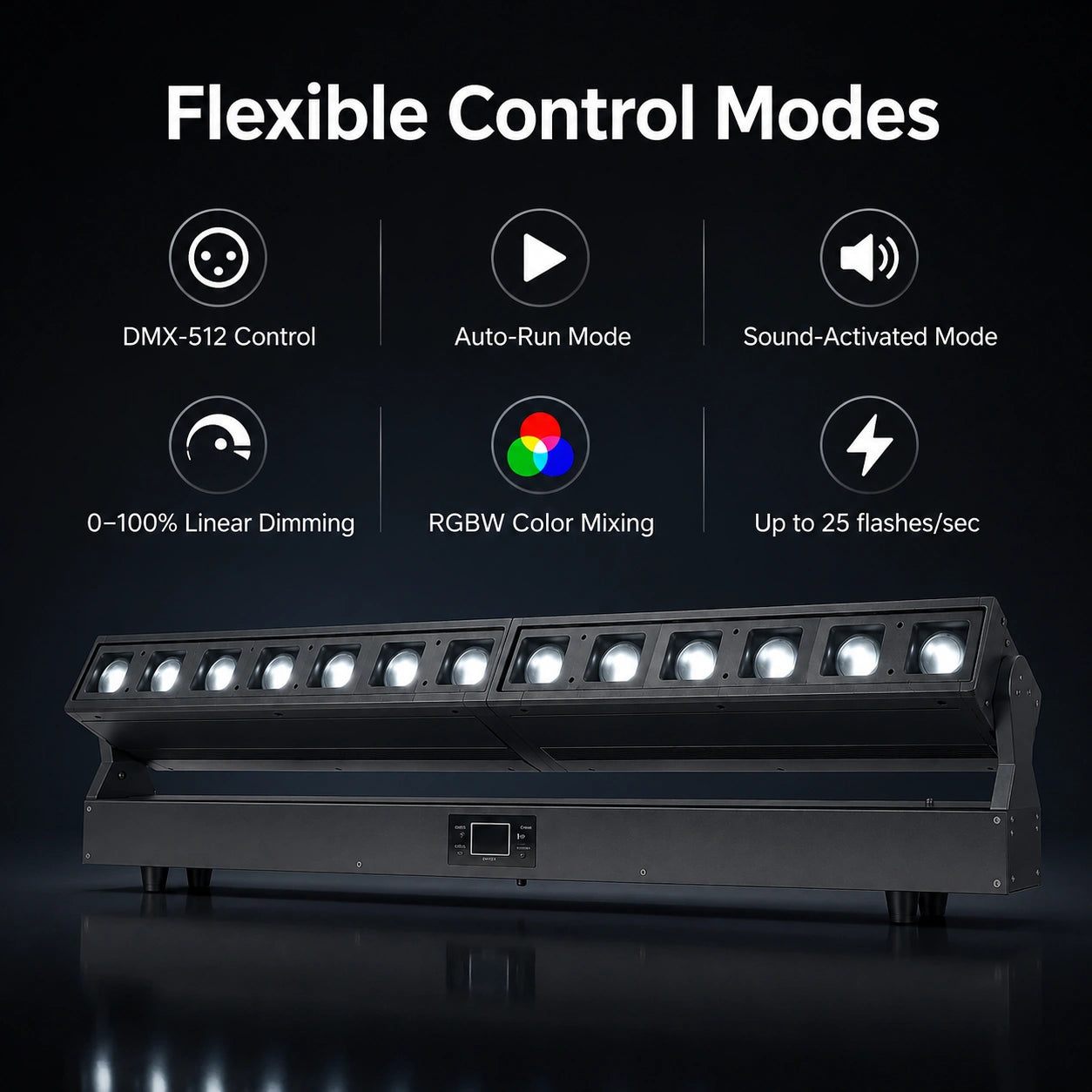
DMX-512 control with 14, 20, and 57-channel modes. Auto-run and sound-activated modes for standalone operation. 500W total power, fan-cooled, 50,000-hour LED lifespan. ~40" wide, ~33 lbs.
What Makes a Beam Bar Different
Traditional moving heads use a single light source — one lens, one beam, one point of output. A beam bar uses multiple sources in a linear array, creating effects that are impossible with single-source fixtures. Twelve individual beams tilting in unison create dramatic sweeping walls of light. Pixel control lets you run chases, color gradients, and individual beam effects across the strip. The zoom switches the entire array between tight parallel beams and a wide wash — two completely different looks from one fixture.
The SF-ST1240 sits at the intersection of beam, wash, strobe, and pixel effect fixture. It replaces multiple single-purpose fixtures in your rig, and the visual impact of 12 beams moving together is fundamentally different from what you get with a single spot or wash head.
| Specification | SF-ST1240 |
|---|---|
| Light Source | 12 × 40W RGBW 4-in-1 LEDs |
| Total Power | 500W |
| Zoom Range | 5°–35° (motorized) |
| Tilt Range | 220° with fine adjustment |
| Pixel Control | Yes — each LED individually addressable |
| Color Mixing | RGBW 4-in-1 with dual reflectors |
| Dimming | 0–100% linear |
| Strobe | Up to 25 flashes per second |
| DMX Channels | 14CH / 20CH / 57CH modes |
| Control Modes | DMX-512, auto-run, sound-activated |
| Power Input | AC 90–240V, 50/60Hz |
| Cooling | Fan-forced |
| LED Lifespan | ~50,000 hours |
| Fixture Size | ~40.2" × 4.2" × 10.5" (102 × 10.75 × 26.6 cm) |
| Weight | ~33 lbs (15 kg) |
| SKU | SFX-SSM-001 |
Applications
- Concert & Touring Stages — Sweeping beam arrays, pixel-mapped effects, and dynamic wash coverage across large stages.
- Nightclubs & DJ Booths — High-energy beam shows, strobe effects, and color chases that fill the room from a single fixture position.
- Theater & Live Performance — Dramatic tilting washes, precise color mixing, and programmable scene looks across 57 DMX channels.
- Houses of Worship — Versatile fixture that serves as beam effect, stage wash, and accent lighting in one unit.
- Corporate Events & Galas — Wide zoom for smooth color washes in low-key settings, tight beams for high-energy reveals.
- Theme Parks & Immersive Environments — Pixel effects for themed sequences, continuous-duty operation with 50,000-hour LED lifespan.
Individual Pixel Control
Each of the 12 LEDs is independently addressable for color, intensity, and strobe. In the 57-channel DMX mode, you get full per-pixel control — assign different colors to each LED, run chases across the bar, create gradients, or isolate individual beams for precise effects. This is what separates a pixel bar from a standard multi-cell wash — every LED is a separate instrument you can program independently.
For simpler setups, the 14-channel and 20-channel modes give you unified control of the full bar without needing 57 channels of DMX per fixture. These are ideal for installations or shows where you want the beam bar's visual format without programming every pixel individually.
Motorized Zoom: 5°–35°
The zoom range transforms the fixture's character entirely:
- 5° (tight) — Twelve razor-sharp parallel beams. Dramatic beam arrays that cut through haze, create aerial effects, and produce the signature "wall of beams" look. This is the high-energy mode for concerts, clubs, and moments that need visual punch.
- 35° (wide) — Broad, overlapping wash coverage. The twelve sources blend into a smooth, wide-format color wash that covers a large area from a single fixture. Stage washes, backdrops, audience washes, and ambient color.
- Mid-range — Blend between beam and wash for intermediate looks. Partially overlapping beams create textured washes with visible structure — more character than a pure wash, softer than pure beams.
The zoom is motorized and DMX-controllable, so you can transition between beam and wash modes mid-show without touching the fixture. Program zoom changes into your cues for dramatic shifts — tight beams for the verse, wide wash for the chorus.
RGBW Color Mixing
Four-color RGBW mixing with dual reflectors for improved color blending. The dedicated white LED element means clean, true whites without the off-color tint you get when mixing RGB to approximate white. Full-spectrum color mixing from saturated primaries to pastels, with smooth 0–100% linear dimming across the entire range.
Movement & Strobe
220° tilt with fine adjustment gives the bar sweeping coverage — the strip format makes tilt movement dramatically more visual than a single-point source because the entire 40" array moves as a unit. Combined with the zoom, tilt movement creates massive sweeping beams or rolling wash coverage that fills the space.
The strobe function hits up to 25 flashes per second — fast enough for punchy impact effects and slow enough for dramatic pulsing. Variable-speed strobe is DMX controllable, and with pixel control, you can run strobe chases across the 12 LEDs for sequenced flash effects.
DMX Channel Modes
| Mode | Channels | Best For |
|---|---|---|
| 14CH | 14 | Basic control — master dimmer, RGBW, tilt, zoom, strobe. Simple setups, installations, limited DMX universes. |
| 20CH | 20 | Enhanced control with additional macro and effect parameters. Good balance of flexibility and channel efficiency. |
| 57CH | 57 | Full pixel control — individual RGBW for each of 12 LEDs plus master controls. Maximum creative flexibility for pixel mapping and per-LED programming. |
Frequently Asked Questions
Q: How does this compare to a traditional moving head wash?
Traditional wash heads produce a single circular beam from one lens. The SF-ST1240 produces 12 individual beams from a linear strip. The visual effect is fundamentally different — a traditional wash gives you a cone of light from one point, while a beam bar gives you a wall of light from a 40" wide source. When zoomed tight, you get 12 parallel beams cutting through haze. When zoomed wide, you get a broad-format wash with more even coverage than a single-point source. The beam bar doesn't replace a traditional wash — it does things a single-source fixture physically can't do.
Q: What DMX controller do I need?
Any standard DMX-512 controller works. For basic operation (14CH mode), any entry-level DMX board is fine. For full pixel control (57CH mode), you'll want a controller that can handle the channel count — 57 channels per fixture adds up quickly with multiple units. Consoles with pixel mapping capabilities (like MA, ChamSys, Avolites, or software like QLC+) let you take full advantage of the individual LED control. The fixture also runs standalone without any controller.
Q: How heavy is it, and what do I need for rigging?
The fixture weighs approximately 33 lbs (15 kg) and is about 40 inches wide. Use appropriately rated clamps and safety cables for any overhead mounting. The wide format means you need to account for the full 40" span when planning truss positions — it's wider than a typical moving head, so spacing between fixtures on truss requires more clearance. Always ensure your truss, clamps, and rigging hardware are rated for the fixture weight plus a safety margin.
Q: Is it noisy?
The SF-ST1240 uses fan-forced cooling, which produces some audible noise. For high-energy events (concerts, clubs, DJ shows), fan noise is not a factor — it's completely masked by the sound system. For quieter environments (theater, corporate, house of worship), be aware that the fans are audible in silent moments. Position fixtures at a distance from the audience if noise sensitivity is a concern.
Q: Can I use it without DMX?
Yes. Auto-run mode cycles through built-in programs automatically. Sound-activated mode responds to music via the built-in microphone. Both modes are useful for simple installations, mobile DJ setups without a lighting console, or as a backup if DMX fails. For full creative control — especially pixel effects — you'll want a DMX controller.
Q: How many can I daisy-chain on DMX?
Standard DMX-512 supports up to 512 channels per universe. In 57-channel mode (full pixel control), you can address up to 8 fixtures per DMX universe (8 × 57 = 456 channels). In 14-channel mode, you can fit up to 36 fixtures per universe. For large rigs with many pixel bars, plan your DMX universes accordingly — you may need multiple universes for full pixel control of a large array.
Q: Does it need haze to look good?
For beam effects (zoomed tight), haze is essential. Beams are only visible in the air when there are particles for the light to hit. Without haze, you'll see the beam's landing spot but not the aerial beam itself. For wash effects (zoomed wide) and pixel color effects, haze enhances the look but isn't required — the light on surfaces and performers is visible regardless. For the full "wall of beams" experience, pair with haze from the Aurà™ haze fluid line.
Q: What's the power draw?
500W maximum at full output. At standard voltage (120V), that's approximately 4.2 amps per fixture. Plan your power distribution accordingly — a standard 15A circuit can handle 2–3 fixtures at full output, but always account for inrush current and other devices on the same circuit. The auto-ranging power supply accepts 90–240V, 50/60Hz, so it works internationally without a voltage converter.
Getting the Most From the SF-ST1240
🎯 Use haze. Seriously. A beam bar without haze is a wash fixture. A beam bar with haze is a spectacle. The tight 5° beam mode creates dramatic aerial effects, but only when there's haze in the air for the beams to hit. Even a light atmospheric haze transforms the fixture from "nice colored lights" to "12 beams cutting through the room." Pair with Aurà™ haze fluids — Essence for persistent haze, or Whisper for subtle atmospherics.
🎯 Start with 14CH or 20CH mode. The 57-channel mode is powerful but complex — 57 channels per fixture is a lot of programming for your first show. Start with 14CH to learn the fixture's behavior (zoom, tilt, color, master dimmer), then move to 20CH for more control, and graduate to 57CH when you're ready to pixel-map individual LEDs. You'll get impressive results even in basic mode.
🎯 Multiple fixtures multiply the impact. One SF-ST1240 is impressive. Two or more tilting in unison or alternating patterns create the large-scale visual impact that beam bars are known for. Pairs are the minimum for symmetrical stage looks. Four across upstage truss creates a dramatic back wall of light. Budget and plan for multiples if your stage design calls for beam bar effects — the format scales dramatically with quantity.
🎯 Account for the fixture width on truss. At 40 inches wide, the SF-ST1240 takes up significantly more truss space than a traditional moving head (typically 12–16 inches). Plan your truss layout with clearance for the full fixture width plus the tilt arc. Two beam bars side by side need roughly 7+ feet of truss span minimum. Check that adjacent fixtures don't collide during tilt movements.
🎯 Use zoom changes as a programming tool. Don't just set the zoom and forget it — the motorized zoom is DMX-controllable, which means you can program zoom transitions into your cues. Tight beams for high-energy moments, zoom open for washes during slower sections, and smooth zoom transitions between the two for dramatic reveals. The audience perceives zoom changes as a "shift in intensity" even though you're not changing the output level.
🎯 Pixel chases through haze are show-stoppers. When you're ready for 57CH mode, the signature move is running color or intensity chases across the 12 LEDs while the fixture is zoomed tight and tilting through haze. The result is 12 individual beams sequentially firing across the room — a flowing, animated wall of light that's one of the most visually striking effects in modern stage lighting. Worth learning the programming for.
🎯 Plan power and DMX before the gig. At 500W per fixture and 57 channels in full mode, multiple SF-ST1240s add up fast. Map out your power circuits (how many fixtures per circuit at what output), DMX universes (how many fixtures per universe in your chosen channel mode), and cable runs before show day. This is a professional fixture that rewards professional planning.
Pairs Well With
- Aurà™ Haze Fluids — Essential for beam visibility. Essence for persistent haze, Whisper for subtle atmospheric.
- SurgeFX Stage Lighting — Browse the full lighting lineup for complementary fixtures.
- SurgeFX Fog Machines — Dense fog for dramatic reveals and atmosphere beneath your beam effects.
💡 Overview & Specs
What Makes a Beam Bar Different
Traditional moving heads use a single light source — one beam from one point. A beam bar uses 12 sources in a linear array. Twelve individual beams tilting in unison create sweeping walls of light. Pixel control runs chases and gradients across the strip. Zoom switches between tight parallel beams and a smooth wide wash — two different fixtures in one.
| Specification | SF-ST1240 |
|---|---|
| Light Source | 12 × 40W RGBW 4-in-1 LEDs |
| Total Power | 500W |
| Zoom | 5°–35° motorized |
| Tilt | 220° with fine adjust |
| Pixel Control | Yes — 12 LEDs individually addressable |
| Color | RGBW 4-in-1, dual reflectors |
| Strobe | Up to 25 flashes/sec |
| DMX | 14 / 20 / 57CH modes |
| Control | DMX-512, auto-run, sound |
| Power | AC 90–240V, 50/60Hz |
| Size | ~40" × 4" × 10.5" |
| Weight | ~33 lbs (15 kg) |
Applications
- Concerts & Tours — Sweeping beam arrays and pixel effects
- Nightclubs & DJ — High-energy beam shows from single positions
- Theater — Dramatic washes and programmable scenes
- Houses of Worship — Beam, wash, and accent in one fixture
- Corporate & Galas — Wide wash for ambient, tight beams for impact
- Theme Parks — Pixel sequences, continuous-duty rated
🎛️ Features & Control
Pixel Control
Each of 12 LEDs is independently addressable for color, intensity, and strobe. In 57CH mode, assign different colors per LED, run chases, create gradients, or isolate beams. Every LED is a separate instrument. Simpler 14CH and 20CH modes give unified bar control without complex programming.
Motorized Zoom: 5°–35°
- 5° tight — Twelve razor-sharp parallel beams cutting through haze
- 35° wide — Smooth, broad color wash from the full array
- Mid-range — Textured washes with visible beam structure
Zoom is DMX-controllable — program transitions between beam and wash mid-show.
RGBW Color Mixing
4-color RGBW with dual reflectors. Dedicated white LED for clean, true whites. Full spectrum from saturated primaries to pastels. Smooth 0–100% linear dimming.
Movement & Strobe
220° tilt — the 40" strip format makes tilt dramatically more visual than single-source fixtures. Strobe up to 25 flashes/sec, variable speed, DMX controllable. Pixel strobe chases across 12 LEDs in 57CH mode.
DMX Channel Modes
| Mode | Channels | Best For |
|---|---|---|
| 14CH | 14 | Basic control, simple setups |
| 20CH | 20 | Enhanced control, good balance |
| 57CH | 57 | Full pixel control, per-LED programming |
❓ FAQ
Frequently Asked Questions
Q: How does this compare to a traditional moving head?
Traditional wash = single circular beam from one point. Beam bar = 12 individual beams from a 40" wide linear source. Different visual effect entirely — walls of light, pixel chases, and broad-format coverage that single-source fixtures can't produce.
Q: What DMX controller do I need?
Any DMX-512 controller works. Basic mode (14CH) = any entry-level board. Full pixel mode (57CH) = plan for the channel count, especially with multiple fixtures. Also runs standalone without any controller.
Q: How heavy is it?
~33 lbs (15 kg), ~40" wide. Use rated clamps and safety cables. Account for the full width when spacing fixtures on truss — wider footprint than standard moving heads.
Q: Is it noisy?
Fan-cooled — some noise. Masked by sound systems at concerts/clubs. Audible in quiet theater or corporate moments. Position at distance if noise-sensitive.
Q: Can I use it without DMX?
Yes. Auto-run (built-in programs) and sound-activated (reacts to music) modes work standalone.
Q: How many per DMX universe?
57CH mode: up to 8 fixtures per universe. 14CH mode: up to 36. Plan universes for large pixel-controlled rigs.
Q: Does it need haze?
For beam effects (tight zoom) — yes, essential. Beams are only visible in the air with haze particles. For wash effects (wide zoom) — haze enhances but isn't required. Pair with Aurà™ haze fluids.
Q: Power draw?
500W max = ~4.2A at 120V. Standard 15A circuit handles 2–3 at full output. Auto-ranging 90–240V works internationally.
🔧 Setup Tips
Getting the Most From the SF-ST1240
🎯 Use haze. Seriously. Beam bar without haze = wash fixture. Beam bar with haze = spectacle. Even light atmospherics transform the fixture from "nice lights" to "12 beams cutting through the room." Aurà™ haze fluids pair perfectly.
🎯 Start with 14CH mode. Learn zoom, tilt, color, and master dimmer first. Graduate to 57CH pixel control when you're ready. Impressive results even in basic mode.
🎯 Multiples multiply impact. One is impressive. Pairs create symmetry. Four across upstage truss = dramatic back wall of light. Budget for multiples — beam bars scale visually with quantity.
🎯 Account for fixture width. 40" wide = significantly more truss space than standard moving heads. Plan clearance for tilt arc. Two side by side need ~7+ feet of truss minimum.
🎯 Program zoom changes. Don't set-and-forget zoom. Tight beams for high energy, wide wash for slow sections, smooth transitions between. Audience reads zoom changes as intensity shifts.
🎯 Pixel chases through haze. The signature move: color/intensity chases across 12 LEDs, zoomed tight, tilting through haze. Animated wall of light. Worth learning 57CH programming for.
🎯 Plan power + DMX early. 500W per fixture and 57 channels in full mode add up fast with multiples. Map circuits, universes, and cable runs before show day.
Pairs Well With
- Aurà™ Haze Fluids — Essential for beam visibility
- SurgeFX Stage Lighting — Complementary fixtures
- SurgeFX Fog Machines — Dense fog for dramatic reveals