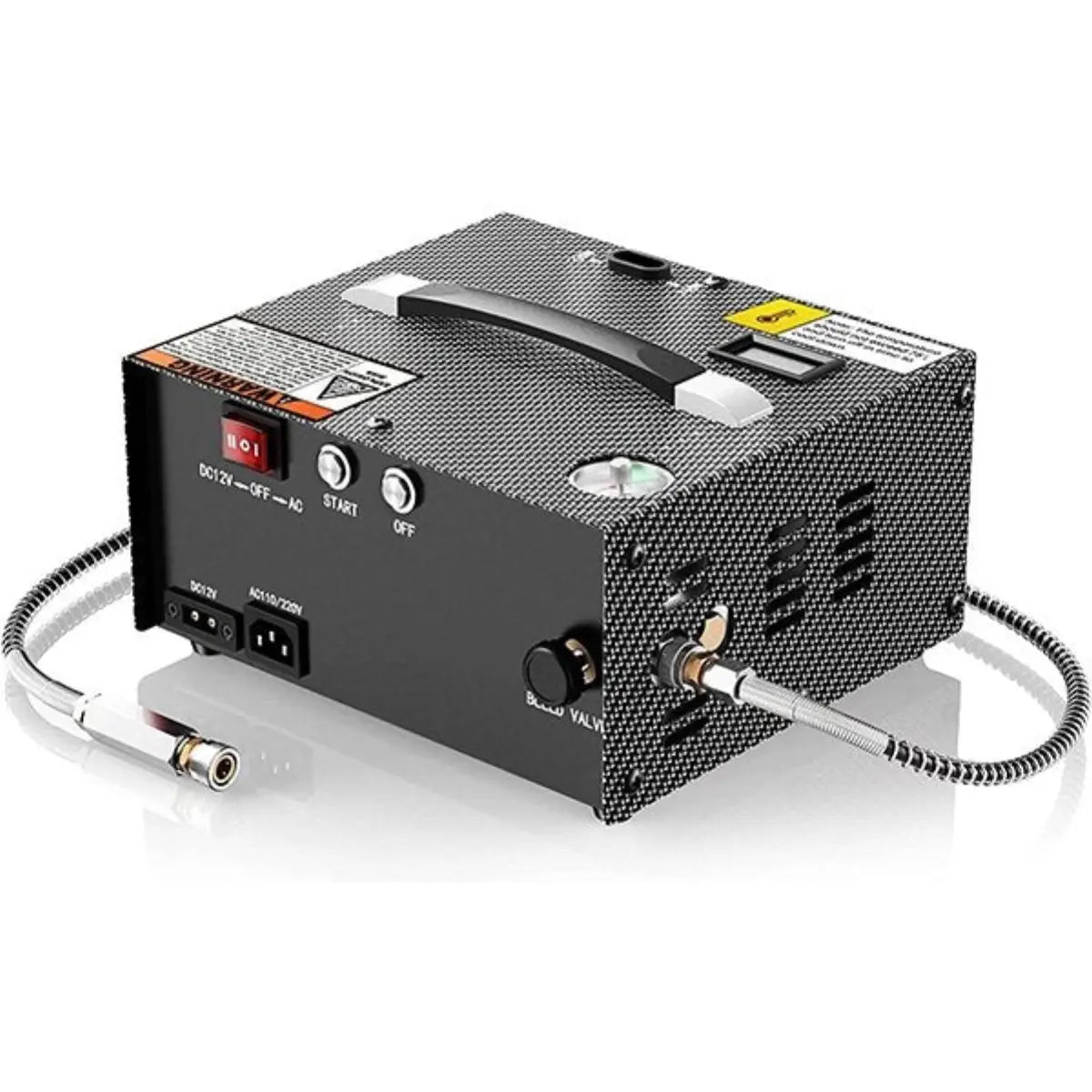
Air Blaster Maxx Quick Fill: 4500Psi Air Compressor Kit
Couldn't load pickup availability
1-Year Warranty Included
Same-Day Shipping (Order by 12PM EST)
Expert Support: Call (866) 577-8743
Shipping information
Shipping information
Warranty information
Warranty information
The Air Blaster Maxx QuickFill is a portable, high-pressure air compressor designed to fill the HPA tanks used with the Air Blaster Maxx Multi-Launcher. It delivers up to 4500 PSI — more than enough to fill the included Tippmann 48ci 3,000 PSI tanks and any other HPA tank in your inventory. Set your target pressure, connect the fill whip, and the compressor does the rest — with an auto shut-off that stops at exactly the pressure you set.
The real advantage is self-sufficiency. Without your own compressor, every empty tank means a trip to a paintball shop, dive shop, or sporting goods store for a refill. With the QuickFill, you fill on-site — between shows, backstage, in the parking lot, from your vehicle. Plug into a wall outlet for home or warehouse fills, or run from a 12V car battery for field fills where there's no power. The compressor is oil-free, fan-cooled, and quiet enough to operate in the same room without disrupting your event prep.
Who Needs Their Own Compressor?
- Multi-Show & Touring Operators — If you're running the Air Blaster Maxx at multiple events per week — concerts, festivals, corporate shows, sports games — you burn through tank fills fast. Driving to a paintball shop between every event isn't sustainable. With the QuickFill, you refill on your own schedule, on your own terms. Top off between shows. Fill in the morning before load-in. Keep every tank at full pressure without depending on a third-party fill station.
- Remote & On-Location Events — Running confetti launches at a beach wedding, a mountain resort, a fairground, a stadium parking lot? There's no paintball shop nearby. The QuickFill runs from a 12V car battery, so you can fill tanks anywhere your vehicle can reach — no wall outlet required. Self-sufficiency is the difference between a smooth show and a scramble to find compressed air.
- Rental Fleet Operators — If you rent Air Blaster Maxx units, you're managing multiple tanks across multiple clients per weekend. Having your own compressor lets you fill and prep every tank in-house before dispatch. No reliance on external fill stations, no coordination gaps, no half-full tanks going out to clients. Full tanks, every time, controlled in your shop.
- Production & Event Companies — Confetti and t-shirt launches are often part of larger production packages. Having a compressor on-site means your air supply is integrated into your production workflow — not an external dependency. Fill during rehearsal, top off between acts, reload during intermission. The compressor fits on a cart or in a road case alongside your other production gear.
- Anyone Tired of Paying Per Fill — Paintball shops typically charge $5–$6 per tank fill. If you're running 4–6 tanks per event across 2–3 events per week, that's $40–$100+ per week in fill fees alone — plus the drive time. The QuickFill pays for itself in weeks, not months. After that, every fill is essentially free.
Specifications
Primary Compatibility
Designed for the Tippmann 48ci 3,000 PSI tanks that ship with the Air Blaster Maxx Multi-Launcher. Set the auto shut-off to 3,000 PSI for these tanks. The compressor's 4,500 PSI maximum capacity means it will also fill any higher-pressure HPA tanks you may acquire in the future — the adjustable shut-off handles both ratings safely.
What's in the Box
Compressor unit, AC power adapter/transformer, 12V DC power cable, 8mm quick-connect fill whip, oil/water separator, and repair kit with vulnerable replacement parts.
How to Fill an HPA Tank
Filling a tank with the QuickFill is straightforward — connect, set your pressure, and let the compressor do the work. The auto shut-off handles the rest.
Step 1: Set Up Power
Connect the compressor to a 110V wall outlet using the included AC adapter, or connect to a 12V car battery using the included DC cable. The compressor draws 300W — well within the capacity of a standard household outlet or a vehicle battery.
Step 2: Set Target Pressure
Use the digital display to set your auto shut-off pressure. For the Tippmann 48ci tanks included with the Air Blaster Maxx, set to 3,000 PSI. The compressor will automatically stop when the tank reaches this pressure — no guessing, no monitoring, no risk of overfilling.
Step 3: Connect the Fill Whip
Attach the 8mm quick-connect fill whip to the compressor's output. Connect the other end to your tank's fill nipple (the small valve port on the tank's regulator). The connection should be snug and secure — you'll hear a click when the quick-connect seats properly.
Step 4: Start Filling
Turn on the compressor. The digital display shows real-time pressure as the tank fills. The built-in fan keeps the compressor cool during operation. Fill time varies by tank size and starting pressure — a completely empty 48ci tank typically takes 15–25 minutes from zero to 3,000 PSI. A partial refill (topping off a half-full tank) takes proportionally less time.
Step 5: Auto Shut-Off & Disconnect
The compressor automatically stops when the tank reaches your set pressure. Disconnect the fill whip from the tank, bleed any residual pressure from the fill line, and your tank is ready to use. That's it — full tank, ready for the next show.
Dual Power — AC and DC Operation
The QuickFill runs on two power sources, giving you flexibility to fill tanks at home, in your shop, or in the field.
Placement & Ventilation
Place the compressor on a flat, stable surface during operation. The built-in fan draws air for cooling — don't block the intake or exhaust vents. Avoid operating in direct sunlight on extremely hot days if possible, as ambient temperature affects cooling efficiency. The overheat protection will shut the compressor down if it gets too hot, so provide reasonable airflow around the unit.
Storage & Transport
The QuickFill is compact enough to fit in a gear bag, road case, or the trunk of a car alongside your Air Blaster Maxx case. Store in a dry location. No oil to worry about — the oil-free design means no fluids to leak or maintain between uses. Just grab it, plug it in, and fill.
Frequently Asked Questions
How long does it take to fill a tank?
A completely empty Tippmann 48ci tank from zero to 3,000 PSI typically takes 15–25 minutes. Topping off a partially depleted tank takes proportionally less time. Larger tanks (68ci, 90ci) take longer. Smaller tanks fill faster. The auto shut-off means you can set it and walk away — come back to a full tank.
Will it fill the tanks that come with the Air Blaster Maxx?
Yes — that's exactly what it's designed for. The Air Blaster Maxx Multi-Launcher ships with a Tippmann 48ci 3,000 PSI tank. Set the QuickFill's auto shut-off to 3,000 PSI and it fills these tanks precisely and safely.
Why does the compressor go to 4,500 PSI if my tanks are 3,000 PSI?
The 4,500 PSI maximum gives you headroom. Your current Tippmann 48ci tanks are rated at 3,000 PSI, and you should always fill to that rating only. But if you later acquire higher-pressure tanks (some HPA tanks are rated at 4,500 PSI), the compressor can handle those too. The adjustable auto shut-off means you always fill to the correct pressure for whatever tank you're using.
Can I fill the tank from my car battery at an event?
Yes. Connect the included 12V DC cable to your vehicle's battery and fill on location — parking lot, backstage, tailgate, wherever your vehicle is. Keep the engine running during fills to avoid draining the battery, especially if filling multiple tanks. This is one of the key advantages of the QuickFill — field fills with no wall outlet needed.
Is it loud?
No. The QuickFill operates quietly — you can run it in the same room without disrupting conversation or event prep. It's not silent (it is a compressor), but it's dramatically quieter than shop compressors or gas-powered units. Suitable for backstage, green room, and indoor use.
Does it need oil or maintenance?
No. The compressor is oil-free — no oil changes, no lubrication schedule, no maintenance fluids. The built-in moisture separator filters water from the compressed air automatically. There are no regular consumables. A repair kit with vulnerable replacement parts is included for long-term use.
Can I fill CO2 tanks with this?
No. The QuickFill fills compressed air (HPA) tanks only. CO2 is a liquefied gas and requires a completely different filling system. The Air Blaster Maxx is compatible with both HPA and CO2, but this compressor is strictly for HPA tanks. If you need CO2, you'll need a CO2 supply from a separate source.
What size tanks can it fill?
Any standard HPA/compressed air tank with a fill nipple — from small 13ci tanks up through large 120ci+ tanks. The Tippmann 48ci tanks used with the Air Blaster Maxx are the primary use case, but the compressor works with any HPA tank. Larger tanks simply take longer to fill.
Can I overfill a tank?
Not with proper use. Set the auto shut-off to your tank's rated pressure (3,000 PSI for the Tippmann 48ci) and the compressor stops automatically. Never set the auto shut-off above your tank's rated maximum pressure. The auto shut-off is your safety net — use it correctly every time.
How many fills can I do back-to-back?
The fan cooling and overheat protection allow for multiple consecutive fills. On AC power, you can typically fill several tanks in sequence with short rest periods between fills to let the compressor cool. The overheat protection will shut the unit down if it needs a longer cool-down period. On 12V DC, battery capacity may be your limiting factor before heat is.
How fast does this pay for itself?
At $5–$6 per paintball shop fill, operating 2–3 tanks per event across 2–3 events per week, you're spending roughly $40–$100+ per week on fills plus drive time. The QuickFill eliminates that cost entirely after purchase. Most active operators recoup the investment within 4–10 weeks depending on usage frequency.
Get the Most from the QuickFill
Fill the Night Before, Not the Morning Of
Top off all your tanks the evening before an event. Let them sit overnight and check pressure in the morning. If a tank has a slow leak (bad o-ring, loose fill nipple), you'll catch it the night before instead of discovering it 30 minutes before showtime. Full tanks sitting overnight also confirm your regulator and burst disc are holding properly.
Keep a Spare Tank in Rotation
With your own compressor, the economics of spare tanks change. A second Tippmann 48ci tank is inexpensive, and with the QuickFill, you can keep it topped off and ready. Swap tanks between shows with zero downtime — fire the first tank, swap in the spare, refill the empty while the show continues.
Run the Engine for 12V Field Fills
When filling from a car battery, keep the vehicle running. The compressor draws 300W over 15–25 minutes per tank — that's a meaningful battery drain. Running the engine keeps the alternator charging while you fill. This is especially important when filling multiple tanks in sequence at a field event.
Set Auto Shut-Off Before Every Fill
Make it a habit — before you connect the fill whip, verify the auto shut-off is set to the correct pressure for the tank you're about to fill. Different tanks may have different ratings. The 3-second check prevents the only serious mistake you can make with a compressor: overfilling beyond a tank's rating.
Let the Compressor Rest Between Consecutive Fills
The fan cooling handles heat during normal operation, but back-to-back fills of multiple tanks can accumulate heat. Give the compressor a few minutes of rest between tanks. This extends the compressor's lifespan and prevents the overheat protection from triggering mid-fill. A 5-minute rest between tanks is a good habit.
Fill In a Well-Ventilated Area
While the compressor itself doesn't produce fumes (it's electric and oil-free), operating in a well-ventilated space helps with cooling efficiency. Avoid filling in a closed, hot trunk or an unventilated storage closet. A table in a garage, an open tailgate, or any area with reasonable airflow is ideal.
Track Your Tank Hydro Dates
With your own compressor, it's tempting to just keep filling and firing. But HPA tanks have a mandatory 5-year hydrostatic test interval. Mark the test dates on your tanks with a label or in your gear inventory. An expired tank should not be filled — period. Keep your tanks in test, and the QuickFill keeps them full.
The QuickFill Is Also a Diagnostic Tool
If a tank isn't holding pressure between events, the QuickFill helps you isolate the problem. Fill the tank, set it aside for a few hours, and check the pressure gauge on the tank. If pressure has dropped, you've got a leak — likely an o-ring on the fill nipple or the regulator. Catching these issues at your shop is far better than discovering them on-site at an event.
✦ Perfect For
- Multi-Show Operators — Fill tanks on your own schedule. No more trips to paintball shops between events.
- Remote/On-Location Events — 12V car battery operation. Fill anywhere your vehicle can reach.
- Rental Fleet Operators — Fill and prep every tank in-house before dispatch. Full tanks, every time.
- Production Companies — Integrate air supply into your production workflow. Fill during rehearsal, top off between acts.
- Cost-Conscious Operators — Eliminates $5–$6 per fill shop visits. Pays for itself in weeks at regular usage.
📋 Specs
Max Pressure: 4,500 PSI (30 MPa / 300 bar)
Power: 110V AC (wall outlet) + 12V DC (car battery) — dual power
Power Rating: 300W
Auto Shut-Off: Yes — adjustable target pressure
Cooling: Built-in fan with overheat protection
Lubrication: Oil-free — zero maintenance fluids
Filtration: Built-in oil/water separator for clean, dry air
Display: Digital pressure gauge + temperature readout
Connection: 8mm quick-connect fill whip
Tank Compatibility: All HPA tanks — 3,000 PSI and 4,500 PSI rated (13ci–120ci+)
In the Box: Compressor, AC adapter, DC cable, fill whip, oil/water separator, repair kit
🔧 How to Fill
1. Connect to power (110V outlet or 12V car battery)
2. Set auto shut-off to your tank's rated pressure (3,000 PSI for Tippmann 48ci)
3. Connect fill whip to tank's fill nipple
4. Turn on compressor — monitor digital display
5. Compressor stops automatically at set pressure
6. Disconnect fill whip, bleed residual pressure from line
Fill time: ~15–25 minutes for empty 48ci tank to 3,000 PSI. Partial refills are faster.
⚡ Power & Setup
🔌 110V AC: Standard wall outlet. Primary method for home/shop/warehouse fills. Consistent power for back-to-back fills.
🚗 12V DC: Vehicle battery. Field fills at event venues, parking lots, remote locations. Keep engine running during fills to prevent drain.
Placement: Flat, stable surface. Don't block fan intake/exhaust vents. Avoid direct sunlight on hot days.
Storage: Compact — fits in gear bag or road case. Oil-free = no fluids to leak in transit.
❓ FAQ
Fill time? ~15–25 min for empty 48ci tank to 3,000 PSI. Partial fills are faster.
Works with Air Blaster Maxx tanks? Yes — designed for the included Tippmann 48ci tanks.
Why 4,500 PSI if tanks are 3,000? Headroom for higher-pressure tanks. Always fill to your tank's rated max, not the compressor's max.
Fill from car battery? Yes — 12V DC with included cable. Keep engine running.
Loud? No — quiet enough for indoor/backstage use.
Oil or maintenance? Oil-free. No maintenance fluids. Repair kit included.
CO2 tanks? No — HPA/compressed air only. CO2 requires a different system entirely.
What size tanks? Any HPA tank with fill nipple — 13ci through 120ci+.
Pays for itself? 4–10 weeks at typical multi-event usage ($5–$6/fill saved per tank).
💡 Pro Tips
Fill the night before — Catches slow leaks before showtime.
Keep a spare tank — With your own compressor, swapping tanks mid-show costs nothing.
Run the engine for 12V fills — Prevents battery drain during 15–25 min fill cycles.
Verify auto shut-off before every fill — 3-second check prevents the only serious mistake.
Rest between consecutive fills — 5 minutes between tanks extends compressor life.
Track hydro test dates — 5-year interval. Don't fill expired tanks.
Use as diagnostic tool — Fill, wait, check. Pressure drop = leak you can fix before the event.